Why Your Afternoon Tea Stops Working After a Few Weeks
Quick Answer: Your afternoon tea stops working because caffeine tolerance builds in roughly 7 to 12 days of daily use, and because a habitual cup at the same time starts landing on adenosine that has already accumulated past the point tea can mask. The fix is not a stronger brew. It is moving the cup 45 to 60 minutes earlier, taking two low-caffeine days a week, and separating the ritual from the stimulant so one still works when the other does not.
Here is what is actually happening in that 3pm cup.

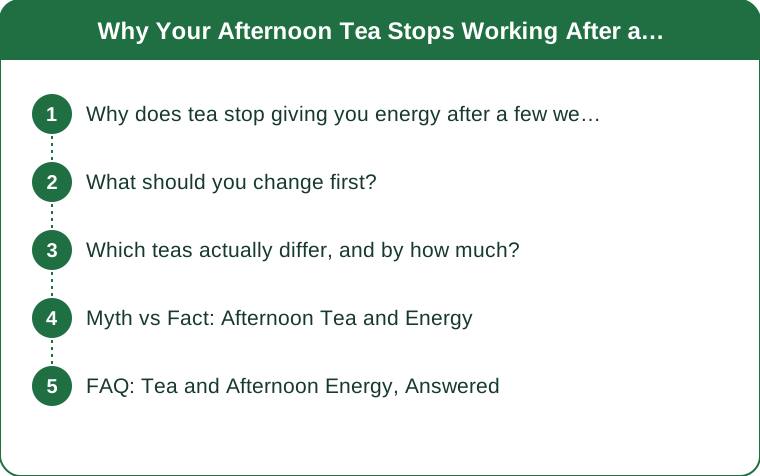
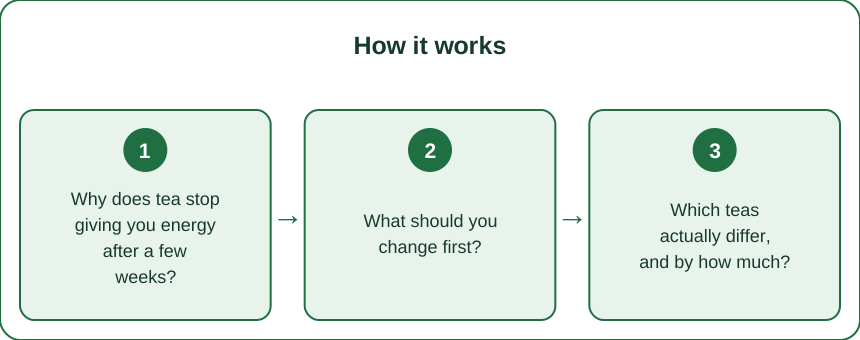
Why does tea stop giving you energy after a few weeks?
Caffeine does not create energy - it blocks the signal that you are tired. Adenosine builds through the day and binds to receptors that make you feel sleepy, and caffeine occupies those receptors instead.
Your body responds by making more receptors. Within about 7 to 12 days of consistent daily intake, there are enough extra adenosine receptors that the same dose covers a smaller proportion of them. Same tea, less effect.
Timing compounds the problem. If the cup has drifted later - 3:30 instead of 2:15 - it is arriving after adenosine has already built up substantially, and blocking late is far less effective than blocking early.
The dose in tea is modest to begin with. A cup of black tea sits around 40 to 70 mg of caffeine against roughly 95 mg in a standard coffee, so there is much less headroom before tolerance swallows the effect entirely.
Sleep debt eats the rest. After a few short nights, the adenosine load is higher than any 50 mg cup can mask, which is why the tea seems to fail precisely during busy weeks.
And the ritual keeps working even when the chemistry does not, which is the part that makes this hard to notice. You still feel better for a few minutes after making it, so you assume the caffeine is doing something.
What should you change first?
Move the cup earlier before you make it stronger. Drinking at 1:30 rather than 3:00 blocks adenosine before the afternoon load peaks, and most people find this alone restores much of the effect.
Take two low-caffeine days per week. Receptor density starts adjusting back within a few days, and two days is usually enough to restore noticeable sensitivity without a full withdrawal week. Weekends work well because the schedule is more forgiving.
Do not chase it with a second cup. A second cup after 4pm has a 5 to 6 hour half-life, meaning roughly half the caffeine is still circulating at bedtime - which raises tomorrow’s adenosine debt and makes tomorrow’s cup weaker still.
Separate the ritual from the stimulant. Keep the exact same routine - kettle, favourite mug, five minutes away from the screen - but make it rooibos or peppermint on the low days. The break is doing more work than you think.
Add 10 minutes of walking to the same slot. A short walk raises alertness through a completely different mechanism, so it stacks with caffeine rather than competing for the same receptors.
Check hydration before blaming the tea. Mild dehydration produces almost exactly the same 3pm fog, and a large glass of water 20 minutes before the cup frequently changes the result on its own.

Which teas actually differ, and by how much?
Matcha and green tea contain L-theanine alongside caffeine, and the combination produces a steadier alertness curve than caffeine alone - less peak, less drop.
Brew time matters more than leaf type for caffeine. A 3 minute steep extracts substantially more caffeine than a 1 minute steep of the same leaf, so shortening the steep is a legitimate way to taper without changing tea.
Second infusions are much lower in caffeine. Most caffeine comes out in the first steep, so a second pour of the same leaves gives you the ritual and the warmth at a fraction of the dose.
Rooibos and most herbals are genuinely caffeine free, which makes them the right choice for the low days rather than a compromise.
Cold brew tea is not automatically lower in caffeine - a long cold steep can extract a comparable amount. The temperature changes the flavour profile, not necessarily the dose.
Chai made with milk slows absorption slightly, which some people experience as a gentler onset. It does not change the total, only the curve.
Myth vs Fact: Afternoon Tea and Energy
Myth: If tea stopped working, you need a stronger brew. Fact: A stronger brew raises tolerance faster. The reliable move is earlier timing plus periodic low days, not a bigger dose.
Myth: Green tea has much less caffeine than black. Fact: The ranges overlap considerably. Steep time, leaf grade, and water temperature move caffeine content more than the black-versus-green distinction does.
Myth: Caffeine after 4pm is fine if you sleep well anyway. Fact: With a 5 to 6 hour half-life, a 4pm cup is still half-present at 10pm. It frequently reduces deep sleep even when you fall asleep normally.
Myth: You need a full week off to reset tolerance. Fact: Two low days a week keeps sensitivity most of the way there for the majority of people, and it is far easier to sustain.
Myth: Herbal tea is a placebo for tiredness. Fact: The warmth, the pause, and the hydration are real effects. What changes is that you stop attributing them to caffeine - which is useful information.
Myth: The afternoon slump is a caffeine problem. Fact: It is largely a circadian dip that happens to almost everyone around 7 to 9 hours after waking. Caffeine masks it; light, movement, and food timing genuinely change it.
FAQ: Tea and Afternoon Energy, Answered
How long does caffeine tolerance take to build?
Roughly 7 to 12 days of consistent daily intake for most people. That is why a new habit feels excellent for the first week and unremarkable by the third.
What is the best time for an afternoon tea?
Earlier than most people take it - around 1:30 rather than 3:00. Blocking adenosine before the load peaks is considerably more effective than blocking it afterwards.
Does a second steep have less caffeine?
Yes, substantially. Most caffeine is extracted in the first infusion, so a second pour gives you the ritual and warmth at a much lower dose.
Will switching from black to green tea help?
A little, mainly because of L-theanine smoothing the curve. But steep time affects caffeine content more than the type of tea does.
Is the 3pm slump caused by caffeine wearing off?
Usually not. It is largely a normal circadian dip about 7 to 9 hours after waking. Caffeine masks it, but light exposure and a short walk address it more directly.
How many low-caffeine days do I need?
Two per week is enough for most people to keep noticeable sensitivity, and it is far more sustainable than an occasional full week off.
Does adding milk change the effect?
It may slow absorption slightly, producing a gentler onset. The total caffeine you take in is unchanged.
TL;DR:
- Tolerance builds in 7 to 12 days of daily use - extra adenosine receptors mean the same cup covers less ground.
- Move the cup earlier (around 1:30) before you make it stronger. Blocking early beats blocking late.
- Two low-caffeine days a week restores most of your sensitivity without a full withdrawal week.
- Steep time changes caffeine more than leaf type. A short steep or a second infusion is a genuine taper.
- Nothing after 4pm - the 5 to 6 hour half-life means half of it is still there at bedtime.
- Keep the ritual, change the contents. The kettle, the mug, and five minutes off-screen are doing real work.
- Check water and daylight first. Mild dehydration and a dim room mimic the same slump.
The afternoon dip is normal physiology, not a failure of your tea. Treat the cup as one tool among several and it starts working again.
Keep Reading
This article is for general informational purposes only and is not medical advice. Always consult a qualified health professional for guidance specific to you.