Why Iced Tea Turns Bitter When the Same Leaves Taste Fine Hot
Quick Answer: Hot tea poured over ice gets diluted by melt water, so people compensate by brewing stronger or longer — and long steeping is exactly what pulls out the astringent compounds. Cold also mutes sweetness far more than it mutes bitterness, so the same liquid genuinely tastes harsher chilled. Brew at 1.5x the leaf, not 1.5x the time, and the bitterness disappears.
You make the same tea every morning and it is fine.
You pour it over ice in the afternoon and it tastes like a mouthful of wet paper bag.
Same leaves, same water, same kettle. What changed is the math and your tongue’s temperature response.

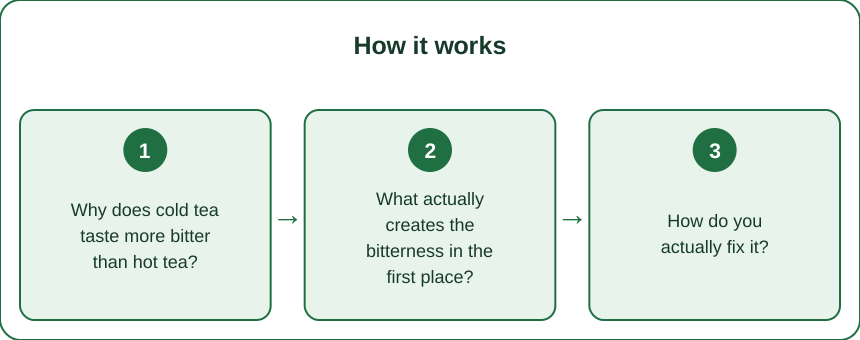
Why does cold tea taste more bitter than hot tea?
Because temperature changes what your tongue can detect, and it does not change all tastes equally.
Sweetness perception drops sharply as a liquid gets colder. Bitterness perception drops much less. So chilling a cup does not turn the volume down evenly — it turns down the thing that was balancing the bitterness and leaves the bitterness roughly where it was.
This is the same reason warm soda tastes sickly sweet and cold soda tastes refreshing at the identical sugar level. Temperature is not a neutral filter.
So a cup of black tea that reads as pleasantly brisk at 175°F can read as harsh at 40°F, without a single molecule changing. If you have ever tasted a hot cup, judged it perfect, and then been ambushed by the iced version, this is why.
What actually creates the bitterness in the first place?
Two groups of compounds, extracted on very different clocks.
The pleasant parts of tea — the aromatics, the sweetness, most of the flavor you actually want — come out early, in roughly the first two to three minutes in hot water. The astringent polyphenols and the caffeine keep extracting well past that point.
So steeping time is not a volume knob. Past a certain point it is a bitterness knob. The first three minutes build the tea; minutes four through eight mostly build the harshness.
The trap with iced tea is that melt water will dilute your cup by roughly a third, and the intuitive fix is to leave the leaves in longer. That gets you the concentration you wanted plus a large helping of the compounds you did not.
The other quiet culprit: reheating or holding hot tea for an hour before icing it. Tannins keep developing in the pot, and a tea that sat warm for forty minutes was already halfway to bitter before the ice arrived.

How do you actually fix it?
Three approaches, in order of how little effort they take.
Increase the leaf, not the time. Use about 1.5 times the leaf you would for a hot cup, steep for the normal time, and pour it over a full glass of ice. You get the concentration back without the extra extraction. This single change fixes most iced tea.
Flash-chill instead of slow-cooling. Brew into a vessel that is already half full of ice so the tea drops below 105°F within seconds. Slow cooling on a counter keeps the leaves and the liquid in the extraction zone far longer, and it also lets the tea go cloudy.
Cold brew for the strongest teas. Leaves in cold water in the fridge for 6 to 12 hours extracts almost no astringency, because the polyphenols need heat to come out efficiently. The result is noticeably sweeter and rounder, with roughly 30 to 40 percent less caffeine. It is the best method for green tea, which is the least forgiving when it is over-extracted.
One more thing worth checking: hard water. Very high mineral content flattens tea and pushes it toward a chalky bitterness, and that effect is more obvious cold. If your hot tea is fine and your iced tea is chalky, try one glass with filtered water before blaming the leaves.
Myth vs Fact: Iced Tea Bitterness
Myth: Bitter iced tea means the tea is low quality. Fact: Fine teas are often more sensitive to over-steeping, not less, because they have more extractable material. A cheap dust-grade bag is more forgiving of an eight-minute steep than a good loose-leaf.
Myth: Adding sugar fixes bitterness. Fact: Sugar masks it, and cold blunts sugar, so you end up adding a surprising amount. Fixing the extraction gets you a better drink with less sweetener.
Myth: Cloudy iced tea is spoiled. Fact: Cloudiness is usually just tannins and caffeine binding as the tea cools slowly. It is a cosmetic sign of slow cooling, not of anything wrong with the tea.
Myth: You should squeeze the bag to get more out of it. Fact: Squeezing forces out the most concentrated, most astringent liquid sitting in the leaves. It is the single fastest way to make a cup harsh.
Myth: Cold brew is weaker. Fact: It is less astringent, which people read as weaker. Flavor concentration depends on your leaf-to-water ratio and steeping hours, and a 12-hour cold brew can be considerably more intense than a hot cup.
FAQ: Iced Tea Questions, Answered
What ratio should I actually start with?
For iced black tea, try 3 grams of leaf per 6 ounces of hot water, steeped 3 minutes, poured over a glass of ice that fills it to the top. That lands close to the strength of a normal hot cup once the ice does its work.
Does this apply to herbal tea?
Less so. Most herbal infusions — rooibos, mint, chamomile, hibiscus — have far fewer astringent polyphenols, which is why they tolerate long steeping. Hibiscus will get more tart, but that is acidity, not bitterness.
Can I save a batch I have already ruined?
Partly. Dilute it with cold water rather than more ice, and add a pinch of salt — salt suppresses bitterness perception more effectively than sugar does, at a level you will not taste. It is a rescue, not a cure.
Is it worth switching to cold brew now that summer is ending?
Cold brew keeps for 2 to 3 days in the fridge and works just as well for the iced-in-the-morning, cold-at-3pm routine that carries into early fall. It is less about the season than about how far ahead you like to work.
TL;DR:
- Cold mutes sweetness much more than bitterness, so the same tea genuinely tastes harsher over ice.
- Melt water dilutes by about a third, and compensating with longer steeping is what creates the astringency.
- Use 1.5x the leaf at normal steeping time, and flash-chill onto ice rather than cooling on the counter.
- For green tea and anything delicate, cold brew 6 to 12 hours — less astringency, less caffeine, rounder flavor.
The leaves were never the problem. You were solving a dilution problem with a time solution, and time is the one variable that only makes tea worse.
Keep Reading
This article is for general informational purposes only and is not medical advice. Always consult a qualified health professional for guidance specific to you.