Why Adding Ice to Hot Tea Ruins It, and the Two Ways Around It
Quick Answer: Dropping ice into a normal-strength hot tea dilutes it to roughly half strength as the ice melts, and the rapid temperature drop also causes tannins and caffeine to bind together and precipitate, which produces cloudiness and a duller flavour. The two reliable ways around it are flash chilling, where you brew at double strength directly over a full glass of ice, and cold brewing, where you never apply heat at all. Both give clear, full-flavoured iced tea.
Brew for the ice, or brew without heat. Not somewhere in between.

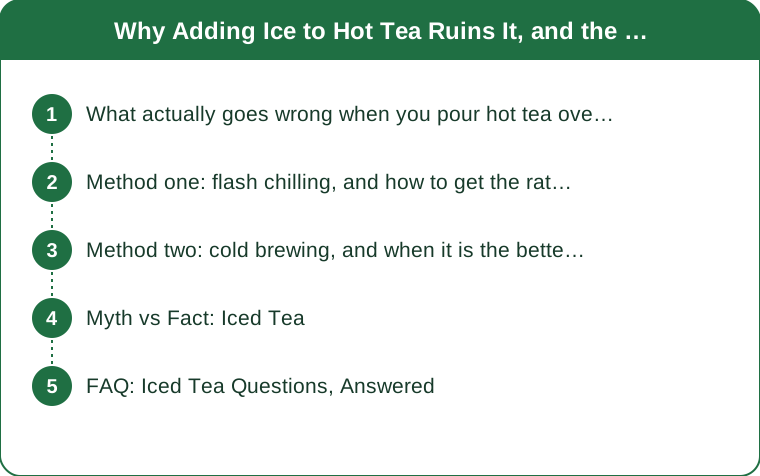
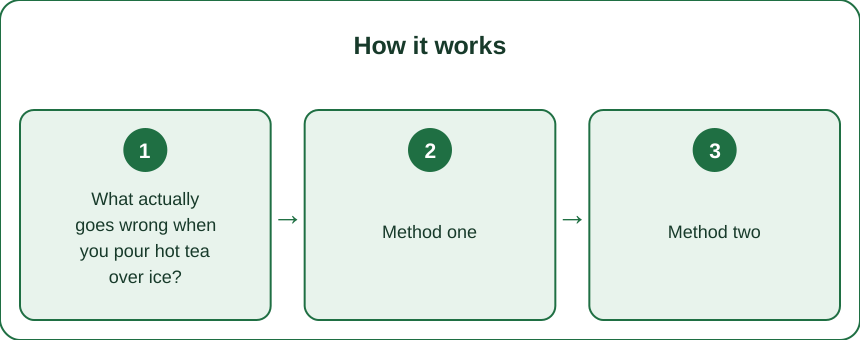
What actually goes wrong when you pour hot tea over ice?
Two separate problems, one obvious and one not.
The obvious one is dilution. Ice melting into hot tea adds a substantial volume of water. Melting a mass of ice roughly equal to the tea more than halves the strength, because melting requires a great deal of energy and that energy comes from the tea’s heat.
A cup brewed to taste hot will taste thin and watery over ice, every time. This is arithmetic, not opinion.
The less obvious one is tea cream. As hot tea cools, polyphenols and caffeine that were dissolved at high temperature bind together and come out of solution, forming a fine suspension. This is what makes iced tea go cloudy, and it is why the phenomenon is called creaming down.
The cloudiness is harmless and it changes the drink. Some of the compounds that carry flavour and astringency are now in suspended particles rather than dissolved, which flattens the taste and gives a slightly chalky edge.
Fast cooling makes it worse. Rapid temperature change encourages the particles to form and stay suspended, whereas very slow cooling, or holding the tea warm, keeps more of it dissolved.
Black teas cream more than green teas, because they contain more of the oxidised polyphenols involved. Hard water accelerates it, because minerals help the particles form.
And aromatics escape. Many of the volatile compounds that make tea smell like tea leave with the steam while the tea is hot. Tea that sits hot and cools slowly loses its aroma to the room before you ever drink it.
Method one: flash chilling, and how to get the ratios right
Brew hot at double strength directly onto a full glass of ice. This is the professional approach and it takes four minutes.
The principle: the ice is part of the recipe, not an addition. You brew half the final volume at double the normal leaf quantity, then pour it over the other half of the volume as ice.
The method:
Use twice the leaf you would for the same volume of hot tea. For a 350ml glass, use the leaf you would normally use for 350ml, and brew it in only 175ml of water.
Brew at the correct temperature and time for the tea — no change here. Black tea near boiling for 3 to 4 minutes; green tea at around 80°C for 2 minutes.
Fill the glass to the top with ice before you pour. Not half full. A full glass of ice cools the tea almost instantly, and rapid cooling through the critical range is exactly what you want for clarity.
Pour immediately and directly over the ice, then stir once.
Why this beats slow cooling: the tea passes through the temperature range where creaming occurs so quickly that the particles have little time to form and aggregate. Fast chilling produces clearer tea than slow cooling in the fridge, which is the reverse of what most people assume.
Common errors: not enough ice, which leaves the tea lukewarm and cloudy; not enough leaf, which produces a weak drink; and letting the hot tea sit before pouring, which loses both aroma and clarity.
Add lemon at the end if you want clarity insurance. Acid keeps the polyphenol complexes dissolved, which is why lemon visibly lightens cloudy iced tea.

Method two: cold brewing, and when it is the better choice
Steep in cold water for hours. Slower, simpler, and a genuinely different drink.
The method: leaf in cold water, in the fridge, for 6 to 12 hours, then strain. Roughly one and a half times the leaf you would use hot, since cold water extracts less efficiently.
What changes chemically: cold water extracts compounds selectively. Caffeine and the more astringent polyphenols dissolve more slowly in cold water than the sweeter amino acids and simple sugars do. The result is a tea that is noticeably smoother, sweeter, and less bitter than the same leaf brewed hot.
Cold brew does not cream. Because the compounds involved never dissolved at high temperature, they do not precipitate on cooling. Cold brewed tea stays clear indefinitely, which is why it looks so good in a jug.
Caffeine is lower but not absent. Cold extraction pulls less caffeine, and the difference depends heavily on time and leaf.
Which teas suit it: green teas, white teas, and floral oolongs are exceptional cold brewed, because the method suppresses exactly the astringency that makes them unforgiving hot. Robust black teas can taste flat, since much of their character comes from compounds that need heat.
When to choose which: flash chilling when you want it in five minutes and you want the full character of a black tea. Cold brewing when you want a jug in the fridge, less caffeine, and a sweeter, softer drink.
Food safety note: use fresh cold water, keep it refrigerated throughout, and drink within a couple of days. Cold brewing at room temperature for long periods is not a good idea.
Myth vs Fact: Iced Tea
Myth: Cloudy iced tea has gone bad. Fact: Cloudiness is creaming down — tannins and caffeine precipitating as the tea cools. It is a normal chemical process and the tea is perfectly fine, just duller in flavour.
Myth: Cooling tea slowly in the fridge is gentler. Fact: Slow cooling through the creaming range produces more cloudiness, not less. Fast chilling over ice gives clearer tea.
Myth: Cold brew is just weak tea. Fact: It is a different extraction. Cold water pulls the sweeter, smoother compounds preferentially and leaves more of the bitter ones behind, which is why it tastes sweeter at the same strength.
Myth: Cold brewed tea has no caffeine. Fact: It has less, and it has plenty. The amount depends on leaf, ratio, and time.
Myth: You need special tea for iced tea. Fact: Any good loose leaf works. The method matters far more than the product, and most bagged iced tea blends are simply strong black tea.
Myth: Sugar dissolves fine in iced tea. Fact: It dissolves poorly in cold liquid and ends up as sludge at the bottom. Make a simple syrup, or sweeten the hot concentrate before it hits the ice.
FAQ: Iced Tea Questions, Answered
Why does my iced tea taste weak?
Because the melting ice roughly doubles the volume. Brew at double strength for flash chilling, or use about one and a half times the leaf for cold brew, and the problem disappears.
How do I stop it going cloudy?
Chill it fast over a full glass of ice rather than slowly in the fridge, use softer water if yours is hard, and add a little lemon. Or cold brew, which does not cream at all.
How long does cold brew tea take?
Six to twelve hours in the fridge, depending on the tea and how strong you like it. Green and white teas are usually ready sooner than black.
Can I reuse the leaves for a second cold brew?
You can, and it will be noticeably lighter. Cold extraction is slow but fairly thorough over a long steep, so a second batch is a gentler drink rather than a full-strength one.
TL;DR:
- Ice melting into normal-strength hot tea halves it, and rapid cooling causes tannins to precipitate and cloud it.
- Flash chill: double the leaf, half the water, pour over a completely full glass of ice.
- Cold brew: one and a half times the leaf, cold water, 6 to 12 hours in the fridge, no cloudiness ever.
- Choose flash chilling for speed and black tea character, cold brew for smoothness and a jug that keeps.
Try the same tea both ways this week. The difference is more dramatic than anything a new tea would give you.
Keep Reading
This article is for general informational purposes only and is not medical advice. Always consult a qualified health professional for guidance specific to you.