Why the Same Tea Tastes Completely Different at Home vs a Café
Quick Answer: Water mineral content, hardness, significantly changes how tea’s flavor compounds extract and taste — water that’s too hard, high mineral content, mutes tea’s flavor and can leave a flat or chalky aftertaste, while water that’s too soft can extract bitterness unevenly, which is why identical tea and technique still taste different depending on your local tap water.
You’ve controlled every variable you can think of — same brand, same steep time, same temperature. The one thing that’s different between your kitchen and that café is the water itself, and it matters more than most people assume.

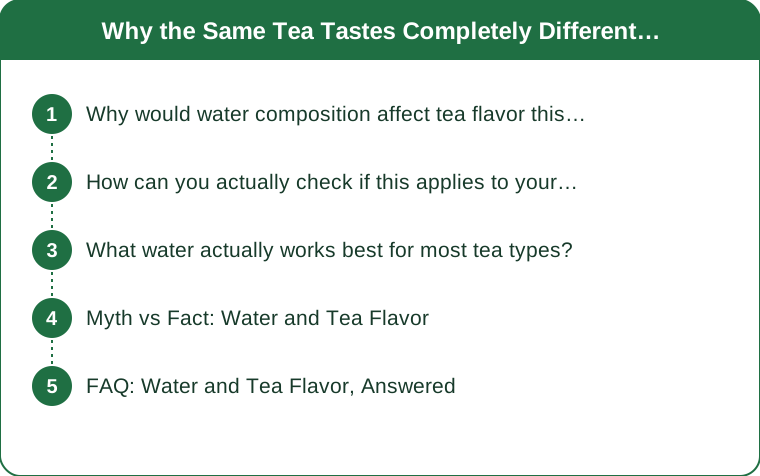
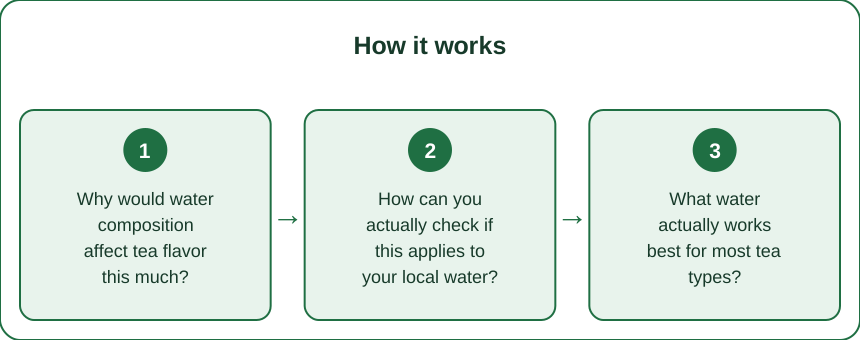
Why would water composition affect tea flavor this much?
Tea’s flavor compounds, including tannins and aromatic oils, interact chemically with the minerals dissolved in water during steeping. Hard water, high in calcium and magnesium, can bind with these compounds in ways that mute flavor complexity and sometimes produce a flat, slightly chalky taste, while very soft or heavily filtered water can extract tannins more aggressively, sometimes producing more bitterness than the same tea would show in moderately mineralized water.
How can you actually check if this applies to your local water?
Most municipal water suppliers publish water hardness data publicly, often searchable by zip code, and this gives a reasonable starting point for understanding whether your tap water leans hard or soft. A simple side-by-side taste test, brewing the same tea with tap water versus filtered or bottled spring water, is also a direct, practical way to notice the difference firsthand.

What water actually works best for most tea types?
Filtered water with moderate mineral content, not heavily distilled, not extremely hard, is generally considered the most reliable middle ground across tea types, since some mineral presence supports flavor extraction while excess hardness mutes it. Many specialty tea shops and cafés use filtered water specifically for this reason, which is part of why their tea often tastes noticeably different from the same leaves brewed at home with unfiltered tap water.
Myth vs Fact: Water and Tea Flavor
Myth: Water is just water, the tea leaves are what determine flavor. Fact: Water mineral content meaningfully changes how flavor compounds extract, sometimes as much as the tea quality itself.
Myth: Distilled water is the best choice since it has no impurities. Fact: Completely mineral-free water can actually extract flavor unevenly and produce flatter results than moderately mineralized water.
Myth: If your tap water tastes fine to drink, it’s fine for tea too. Fact: Water that tastes neutral on its own can still meaningfully mute or distort tea’s more delicate flavor compounds during steeping.
FAQ: Water and Tea Flavor, Answered
Does bottled spring water work better than a home filter pitcher?
Both can work well — the key factor is moderate mineral content, which many spring waters and standard filter pitchers both provide, just check the mineral content listed if available.
Does water quality matter more for delicate teas like green or white tea?
Yes, noticeably more, since their more subtle flavor compounds are more easily muted or distorted by water quality than a stronger black tea or chai blend.
Is it worth testing multiple water types before settling on one?
Yes, a simple side-by-side taste test with two or three water sources is the most direct way to find what actually works best for your palate and local water.
TL;DR:
- Water mineral content, hardness, significantly affects how tea’s flavor compounds extract during steeping
- Hard water tends to mute flavor and can leave a flat aftertaste; overly soft water can extract more bitterness
- Checking local water hardness data or doing a side-by-side taste test reveals whether this applies to you
- Filtered water with moderate mineral content is generally the most reliable choice across tea types
Next time you brew, try the same tea with filtered water instead of straight tap water and taste the difference directly, for many people, this single change closes most of the café-versus-home flavor gap.
Keep Reading
This article is for general informational purposes only and is not medical advice. Always consult a qualified health professional for guidance specific to you.