Tea or Coffee Before a Workout? What Actually Changes Your Performance
Quick Answer: Coffee delivers caffeine faster and in a higher concentrated dose, making it better for a quick performance boost close to workout time, while tea’s slower-releasing caffeine paired with L-theanine tends to produce steadier, less jittery energy that some people prefer for longer or lower-intensity sessions.
Both get you caffeinated, but they don’t get you there the same way — and which one actually helps your specific workout depends on more than just habit or taste.

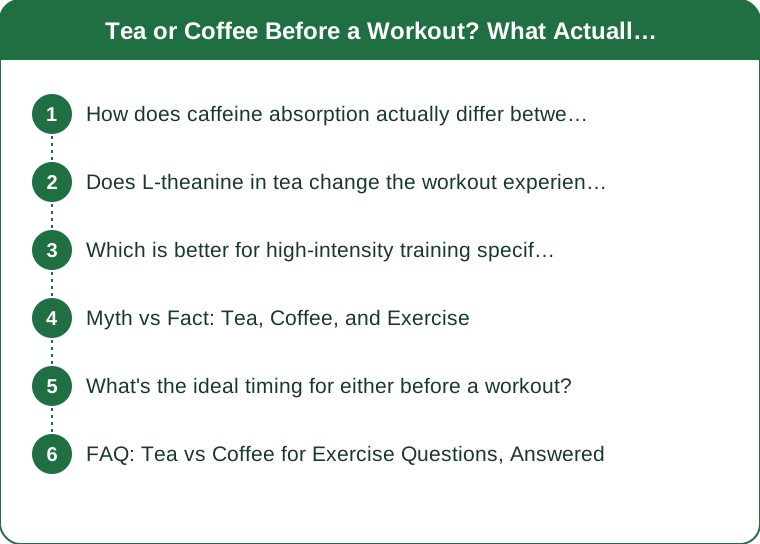
How does caffeine absorption actually differ between tea and coffee?
Coffee typically delivers caffeine faster and in a more concentrated dose per cup — around 95mg in an 8oz cup versus roughly 30-50mg in a comparable cup of black tea — meaning coffee tends to produce a quicker, more noticeable spike in alertness. Tea’s caffeine, by contrast, is released somewhat more gradually, partly due to how it interacts with tannins in the leaf.
For a workout happening within 30-45 minutes, coffee’s faster onset is often the more reliable choice if the goal is a clear performance boost right when you start.
Does L-theanine in tea change the workout experience?
Yes — tea naturally contains L-theanine, an amino acid that promotes a calmer, more focused alertness rather than the sharper stimulation caffeine alone produces. Research on the tea combination suggests it can reduce the jittery, anxious feeling some people get from caffeine while still providing a real cognitive and energy boost.
For lower-intensity or longer-duration sessions (yoga, steady-state cardio, long walks) where sustained calm focus matters more than an explosive energy spike, this combination can be a genuine performance advantage over coffee’s sharper curve.
Which is better for high-intensity training specifically?
For HIIT, heavy lifting, or anything requiring a fast, strong burst of alertness and power, coffee’s faster and higher caffeine dose tends to align better with what the research on caffeine and athletic performance actually measures — most performance-enhancement studies use caffeine doses more consistent with a strong cup of coffee than a cup of tea.
That said, some tea varieties like matcha deliver considerably more caffeine than typical steeped tea (closer to 70mg per serving) while still carrying L-theanine, making it a middle-ground option worth considering for intense training if straight coffee feels too jittery.

Myth vs Fact: Tea, Coffee, and Exercise
Myth: Tea has basically no caffeine, so it won’t help before a workout. Fact: while lower than coffee, tea’s caffeine content is still enough to produce a measurable alertness and performance effect, particularly in stronger black teas and matcha.
Myth: More caffeine always means better performance. Fact: beyond a certain dose (roughly 3-6mg per kg of body weight), additional caffeine mostly adds jitteriness without further performance benefit, and can even hurt performance through anxiety or GI discomfort.
Myth: Tea and coffee caffeine work identically in the body. Fact: the presence of L-theanine and different absorption rates genuinely changes the subjective and some physiological experience, even at comparable caffeine doses.
What’s the ideal timing for either before a workout?
For coffee, 30-45 minutes before exercise aligns with peak blood caffeine levels for most people. Tea’s more gradual release means 45-60 minutes before may work better to let the caffeine fully build up by the time you start.
Both should generally be consumed with some food or at least water if you’re sensitive to caffeine on an empty stomach, since GI discomfort during a workout is more disruptive to performance than a slightly later caffeine peak.
FAQ: Tea vs Coffee for Exercise Questions, Answered
Can I combine tea and coffee before a workout?
It’s generally fine in moderation, but stacking two caffeine sources makes it easier to accidentally exceed a comfortable dose — track total caffeine rather than treating them as separate allowances.
Does matcha count as tea or something in between for this purpose?
Matcha is technically tea but has a caffeine profile closer to a moderate coffee, making it a reasonable middle option if you want more caffeine than steeped tea but still want the L-theanine calming effect.
Is decaf tea or coffee ever useful before a workout?
Minimally for the caffeine effect, but the ritual and hydration can still be worthwhile — just don’t expect a performance boost from decaf versions of either.
TL;DR:
- Coffee delivers faster, higher-dose caffeine — better for high-intensity sessions needing a quick boost
- Tea’s L-theanine pairing gives steadier, less jittery energy — good for longer or lower-intensity workouts
- Matcha is a reasonable middle ground with more caffeine than steeped tea plus L-theanine
- Time coffee 30-45 minutes before, tea 45-60 minutes before, for peak effect at workout start
Neither is objectively better — the right choice depends on what kind of workout you’re walking into and how your body responds to a sharp spike versus a steadier build.
Keep Reading
This article is for general informational purposes only and is not medical advice. Always consult a qualified health professional for guidance specific to you.