Why Your Tea Turns Bitter Even When You Get the Temperature Right
Quick Answer: Bitterness in tea often comes from oversteeping, not incorrect water temperature — tannins and caffeine continue extracting the longer leaves sit in hot water, so even correctly-tempered water produces bitter tea if steep time runs even 1-2 minutes past the recommended window for that tea type.
Most tea guides emphasize water temperature heavily, leaving steep time as an afterthought — but it’s an equally, sometimes more, important variable for bitterness specifically.
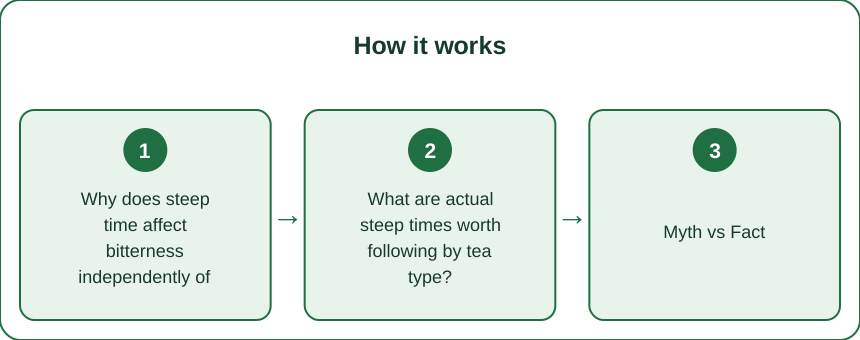
Why does steep time affect bitterness independently of temperature?
Because tannin and caffeine extraction is a time-dependent process that continues as long as leaves stay in contact with hot water, regardless of whether that water started at the ideal temperature. Correctly tempered water that’s left steeping too long still over-extracts these bitter compounds — temperature affects extraction rate, but time determines total extraction.
What are actual steep times worth following by tea type?
Green tea: 2-3 minutes (oversteeping green tea produces bitterness fastest of any type). Black tea: 3-5 minutes. Oolong: 3-5 minutes, often re-steepable multiple times at shorter intervals. White tea: 4-5 minutes, more forgiving than green. Herbal/tisane: 5-7 minutes, generally the most forgiving category since there’s no tea plant tannin content to over-extract.

Myth vs Fact: Tea Bitterness
Myth: Using boiling water always ruins delicate teas. Fact: Boiling water on green tea does increase bitterness risk faster, but the actual ruin factor is usually steep time combined with high heat, not heat alone — a shorter steep with hot water can still produce a good cup.
Myth: More tea leaves means stronger, not more bitter, tea. Fact: More leaves relative to water increases extraction speed, meaning the same steep time produces more bitterness with a heavier leaf ratio — leaf quantity and steep time interact, they don’t operate independently.
Does removing the leaves immediately after steeping actually matter?
Yes, significantly — leaves left in the pot or cup after the intended steep time keep extracting, even after you’ve technically ‘finished’ steeping and started drinking. Removing leaves or using a timer-based infuser that lifts out cleanly prevents this continued extraction from turning the later part of the cup bitter.
FAQ: Tea Steeping Questions, Answered
Does re-steeping the same leaves produce more or less bitterness?
Generally less on the second steep for many tea types, especially oolong, since the compounds that extract fastest (including some bitter tannins) are already reduced from the first steep.
Is bitterness always a sign of a steeping mistake, or can it be the tea itself?
Some teas are simply more naturally robust or slightly bitter by character (certain black teas, some green teas) — comparing your result to a known reliable steep time for that specific tea type helps distinguish character from a genuine oversteeping mistake.
Does water quality affect bitterness the same way steep time does?
Minerally heavy or chlorinated tap water can affect overall taste and clarity, but it’s a separate variable from steep-time-driven bitterness — both are worth controlling independently for the best result.
TL;DR:
- Oversteeping, not just wrong temperature, is a major independent cause of tea bitterness
- Match steep time to tea type: green 2-3min, black 3-5min, oolong 3-5min, white 4-5min
- Remove leaves promptly after steeping — they keep extracting even after you start drinking
- Some teas are naturally more robust in flavor; compare to a known reliable steep time before assuming a mistake
Set a timer specific to your tea type — it solves bitterness complaints faster than adjusting water temperature alone.
Keep Reading
This article is for general informational purposes only and is not medical advice. Always consult a qualified health professional for guidance specific to you.