Why Tea's Caffeine Feels So Different From Coffee's, Even at Similar Doses
Quick Answer: Tea contains L-theanine, an amino acid that moderates caffeine’s stimulating effect and slows its absorption, producing a steadier energy curve with less of the sharp spike and crash pattern coffee tends to cause — even when the total caffeine amounts are fairly similar.
It’s a common experience: two cups of tea can feel noticeably calmer and more sustained than a single cup of coffee, even in cases where the actual caffeine content isn’t wildly different. The difference isn’t really about quantity — it’s about what else is in the cup.

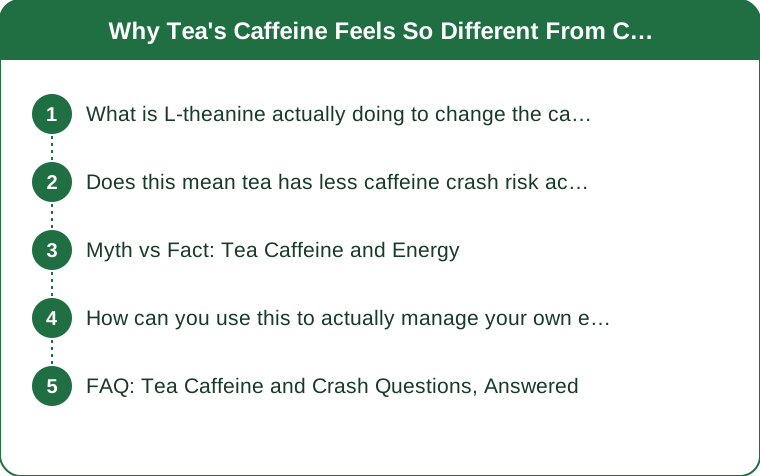
What is L-theanine actually doing to change the caffeine experience?
L-theanine is an amino acid found naturally in tea leaves that promotes alpha brain wave activity, associated with a state of calm alertness, while also slightly slowing how quickly caffeine is absorbed into the bloodstream. This combination produces the ‘calm energy’ effect tea drinkers often describe — caffeine’s stimulating effect is still present, but it’s tempered rather than raw.
Coffee doesn’t contain L-theanine at all, which is a large part of why its caffeine hits in a more immediate, unmoderated way.
Does this mean tea has less caffeine crash risk across the board?
Generally yes, though the effect size varies by tea type — black tea has more caffeine and less L-theanine relative to green tea, so it produces a more coffee-like effect than a delicate green or white tea would. Matcha, which uses the whole tea leaf rather than a steeped-and-discarded leaf, contains notably more L-theanine than regular steeped green tea, often producing one of the smoothest, longest energy curves among common tea types.
This is why not all teas feel equally ‘gentle’ — the caffeine-to-L-theanine ratio shifts meaningfully across tea types.

Myth vs Fact: Tea Caffeine and Energy
Myth: All tea has dramatically less caffeine than coffee. Fact: Some black teas and especially matcha can approach or occasionally exceed lower-end coffee caffeine amounts — the difference is more about the experience than the raw quantity.
Myth: The ‘no crash’ effect from tea is purely psychological or anecdotal. Fact: L-theanine’s effect on brain wave activity and caffeine absorption is measurable in research, not just a subjective impression.
Myth: Decaf tea provides the same calm-alertness benefit since it still has L-theanine. Fact: Decaf tea retains L-theanine but loses the caffeine that L-theanine is specifically moderating, so the ‘calm energy’ effect is much smaller without that combination.
How can you use this to actually manage your own energy through the day?
For an afternoon slot where a jittery crash would be disruptive, choosing a higher L-theanine tea (matcha or a quality green tea) over coffee provides a more sustained lift without the later dip. For a morning where a stronger, faster hit is genuinely wanted, black tea or coffee remains the more appropriate choice, since the goal there is different from an afternoon steady-state need.
Matching the tea type to the specific energy curve you want, rather than treating all caffeinated drinks as interchangeable, is the more useful framework here.
FAQ: Tea Caffeine and Crash Questions, Answered
Does steeping time affect how much L-theanine ends up in the cup?
Yes — longer steeping generally extracts more L-theanine alongside more caffeine, though the specific ratio still depends heavily on tea type.
Is matcha’s higher L-theanine content why it feels different from regular green tea?
Largely yes — since matcha uses the whole ground leaf rather than a steeped-and-removed leaf, it retains significantly more L-theanine and caffeine than a typical steeped cup.
Can taking an L-theanine supplement alongside coffee replicate tea’s effect?
Some people do this specifically to smooth out coffee’s crash, and anecdotal reports are generally positive, though it’s a different approach than drinking tea itself.
TL;DR:
- L-theanine in tea moderates caffeine’s stimulating effect, producing a steadier energy curve than coffee
- Not all teas are equally ‘gentle’ — black tea and matcha have different caffeine-to-L-theanine ratios
- The calm-alertness effect is measurable, not just anecdotal, from research on L-theanine and brain wave activity
- Matching tea type to the specific energy need (steady afternoon vs. quick morning boost) is more useful than treating all caffeine sources the same
If coffee’s crash has never quite worked for your afternoon, the smoother alternative was likely sitting in your tea cabinet the whole time.
Keep Reading
This article is for general informational purposes only and is not medical advice. Always consult a qualified health professional for guidance specific to you.