Why Oversteeped Green Tea Turns Bitter Faster Than Black Tea Does
Quick Answer: Green tea is less oxidized than black tea, which leaves more delicate catechins and tannins exposed and quick to over-extract into bitterness within just 1-2 minutes past the ideal steep time, while black tea’s oxidation process has already broken down many of those same compounds, giving it a much wider margin before it turns bitter.
You get distracted for two extra minutes and the green tea in your cup goes from pleasant to sharply bitter. Do the exact same thing with a mug of black tea and it barely registers as a difference — that’s not inconsistency, it’s a real difference in how the two teas are processed.

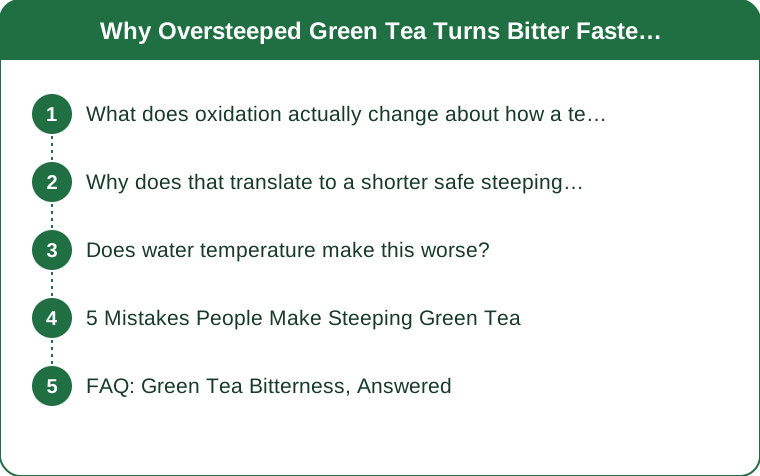
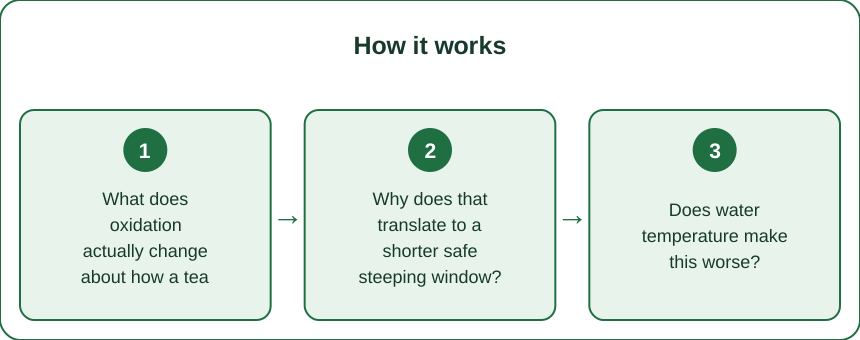
What does oxidation actually change about how a tea steeps?
Oxidation is a controlled processing step where tea leaves are exposed to air, triggering chemical changes that break down certain harsh compounds (catechins) into milder ones. Black tea is fully oxidized during processing, black tea’s harsher compounds have largely already transformed before the leaves ever reach your cup. Green tea is minimally oxidized, so those same harsh, bitter-prone compounds remain largely intact and ready to release quickly into hot water.
Why does that translate to a shorter safe steeping window?
Because green tea’s catechins and tannins are more concentrated and less broken down, they extract into water faster and more intensely the longer the leaves sit in hot water. Most green teas have a safe steeping window of about 2-3 minutes, after which bitterness compounds rapidly — while black tea often has a 4-6 minute window with a much more gradual bitterness curve.

Does water temperature make this worse?
Yes, significantly — green tea steeped in water that’s too hot (near boiling, rather than the recommended 160-180°F) extracts bitter compounds even faster, compounding an oversteeping mistake. Black tea’s typically recommended near-boiling water temperature doesn’t carry the same risk, since its already-oxidized compounds are more heat-stable.
5 Mistakes People Make Steeping Green Tea
1. Using boiling water instead of 160-180°F. This alone can make even a correctly timed steep taste harsher than intended.
2. Walking away and forgetting a timer. Green tea’s bitterness curve is steep enough that even 60-90 extra seconds matters.
3. Reusing the same steep time across all green tea types. Delicate types like sencha need less time than heartier types like genmaicha.
4. Steeping in a mug with leaves left loose, no way to remove them. Without a strainer, the leaves keep steeping even after you’ve decided it’s done.
5. Assuming a second steep needs the same timing as the first. Second steeps of the same leaves usually need slightly less time, since more compounds are already released.
FAQ: Green Tea Bitterness, Answered
Can you fix an oversteeped cup of green tea?
Not fully — a small amount of honey or a splash of milk can mask some bitterness, but the chemical extraction itself can’t be reversed once it’s happened.
Does tea bag vs loose leaf change the steeping window?
Bag tea often has smaller, more broken leaf pieces which extract faster, so bagged green tea can turn bitter even quicker than loose leaf at the same time.
Is bitterness ever a sign of tea quality rather than steeping mistake?
Occasionally, yes — very cheap, low-grade green tea can taste bitter even steeped correctly, but for most mid-to-high quality teas, bitterness points to steeping time or temperature first.
TL;DR:
- Green tea’s lower oxidation leaves more bitter-prone compounds intact, unlike fully oxidized black tea
- Green tea’s safe steeping window is roughly 2-3 minutes versus black tea’s 4-6 minutes
- Water that’s too hot accelerates bitterness in green tea far more than in black tea
- A timer and correct water temperature matter more for green tea than almost any other single factor
The bitterness isn’t a flaw in the tea — it’s built into how much less forgiving green tea’s chemistry is compared to black.
Keep Reading
This article is for general informational purposes only and is not medical advice. Always consult a qualified health professional for guidance specific to you.